
Hello, dear readers. I set blogging aside for a while for two reasons: I had an injury that made it physically impossible to sit and write for several months; and with how much that injury held up my dissertation work, since then, I’ve put 100% of writing effort into finishing in-progress chapters.
I’m happy to report that my injury is significantly improved, and I’m now in the midst of writing a new chapter on medievalism and progressive rock. So without further ado, let’s start looking at some of the shenanigans of ’70s nerds. Last time I wrote about fantasy metal, I got sick and developed a fever. The same thing happened again, while writing this, so forgive me if this post is more rambling that usual. But we all know the prescription when one has a fever, so it’s as good a time as any for listening to the Blue Öyster Cult.
Let me lead with a short but important appeal: please listen to the music linked. I know no one wants to stop what they’re doing and click outside links or start videos. But this is a music blog. You have to listen to the music. Even if you know the song. I’m literally an expert, and I stop to listen to the music before trying to talk about it, in every single instance. There. I have spoken.
Anyone who has a passing familiarity with prog knows that myth and legend are no small part of the genre. It’s one of the quintessential ’70s and early ’80s stereotypes: the tween or young teen boy in his basement, listening to King Crimson or Uriah Heep (or Black Sabbath, and Rainbow—but that’s a different chapter) and playing Dungeons & Dragons.
As one contributor to an RPG forum put it, in response to a request for old school DnD jams, “Endless Skies by Ashbury. If you were smoking a joint while rolling up characters in the back of a van with a wizard painted on the side in 1983, this is what would be playing on the stereo.”
I’d never heard of Ashbury. They don’t even have a Wikipedia page. But check out the majesty of this album cover:

It opens with a song called “The Warning,” a tale that begins thus:
Looking through the keyhole as you hear the thunder roar
You see the lightning flashing but you know not what it’s for
There looks to be a stallion with a rider on its back
You have seen him pass and know that he’ll be back
He looks to be a wizard or perhaps a magic man
With eyes of liquid fire, golden staff within his hand…
Oh yeah. That’s the stuff. Apparently Ashbury has joined the litany of ’70s and ’80s metal bands with cult followings to reunite in recent years (see: Anvil, Pentagram), so that’s fun.
Ashbury is hard rock, not prog, but in the earliest years of both genres, it doesn’t really matter—and as Ashbury’s 1983 album shows, even later, the two genres probably had more in common than either cared to admit. By the end of the ’70s, the relationship between prog and metal was antagonistic, but in those latter days, if they still had one thing in common, it was smoking weed in a van with a wizard painted on it.
Early hard rock has a lot in common with prog musically because of psychedelia, from which they both grew. Compare “War Pigs” to “21st Century Schizoid Man.” Both sound like longer, heavier psych songs—expanded, moody jams with contrasting tempo changes and jazz-influenced drumming—but one band is called the godfathers of heavy metal, while the others are the godfathers of prog. (You’ll also note the common theme of a world gone mad with war.)
So what exactly was the difference between prog, psychedelia, and hard rock c. 1970? Blue Öyster Cult or Deep Purple, for example, could be all three at once (and peep DP’s Bosch album cover).
Jethro Tull showcase some of the common ground of supposedly disparate genres pretty well. They were literally a hard rock and prog rock band, spanning folk, classical, and blues elements—elements which metal incorporated, too. The title song of their so-called first true prog album, Aqualung (1971), is the perfect example. It begins with a classic hard rock riff but proceeds in an unconventional, narrative song form, changing tempos, instrumentation, and musical style with each song section. Tull’s balance of hard rock and folky elements tipped and teetered throughout the ’70s and ’80s, but they always kept that continuum.
Synthesizer-heavy prog such as Yes or Camel helps to make a clearer sonic distinction among genres, but as bands such as Tull demonstrate, you don’t need a Moog-defined sound to be prog. “What is prog?” is still pretty hotly contested—so, I don’t see why we need to persist in thinking of genres in which some fans or critics were publicly antagonistic to each other as being musically antagonistic.
I was listening to an interview with Marc Bolan (of T. Rex—not prog, but another of psychedelia’s offspring, glam) the other day, in which he said that one of the reasons he made Electric Warrior was to try to bring Americans into the scene. He wrote more matter-of-fact, direct lyrics for many songs on the album because, as he said, Americans didn’t get all of the mythology. It was just a part of UK culture, especially at that time, and that’s one reason you find myth and fantasy all over the music of the ’60s and ’70s, and beyond. So in England, you didn’t have to be a nerd to write an album about Siddhartha or create your own elaborate melodrama…but it helped.
As I’m trying to steer myself away from hard rock and back to prog, I’m realizing that very little of the prog I’m writing about in my dissertation is actually fantasy oriented, in the classic wizards, elves, and dragons sense. Tull’s lyrics are often influenced by the history and folklore of Britannia, for example, but they never wrote songs about Gandalf or fairies. That’s really the domain of hard rock/metal, I think. Prog perhaps tends toward the literary, toward mythology, allegory, and actual historical legends, while hard rock and early metal tend more toward legends they made up while high in the back of their vans. Or to put it another way, when the representative prog bands write fantasy lyrics, they usually aren’t simply musical settings of last week’s DnD campaign. (No shade to metal bands, but, most of them weren’t hiring Michael Moorcock to write their lyrics.)
Case in point: King Crimson, whose debut album In the Court of the Crimson King (1969) is essentially patient zero for progressive rock (in addition to being the missing link for so many subsequent musical subcultures), tends to use lyrical medievalism as a critique of modern society, which is typical of late ’60s artists. Their name itself, King Crimson, is a term for a ruler during a time of unrest, and many lyrics on their debut album deal with the Vietnam war, anxiety about nuclear weapons, and so forth. The title song literally describes an imaginary court, but apart from the mention of a “fire witch,” it lacks any overtly fantastic elements.
There’s one recurring trait of the lyrics that is very typical of psychedelia: the texture of scenery is described in loving detail, and everything has a color. This is, unintentionally, one huge way that psychedelic artists do medievalism, because this attention to material detail is characteristic of medieval literature (see this extract from the 14th century poem Pearl). So when someone is singing about purple pipers and yellow jesters, it’s really too perfect.
Rush wrote a similarly unintentionally medievalist—well, medievalist-adjacent—song with “Xanadu,” which is based on the Coleridge poem “Kubla Khan.” Coleridge’s poem is a dream-vision allegory, a genre that was most popular during the Middle Ages (see Pearl again).
On the other end of the ’70s, artists such as Klaatu show how tastes had shifted from The Lady of the Lake to Luke Skywalker, but fantasy and sci-fi have always gone hand-in-hand. This is abundantly clear in mid-70s prog. Van der Graaf Generator‘s sci-fi influence is immediately apparent, but even they wrote the requisite songs about necromancers and medieval witchcraft.
The band Camel, for example, is known for their spacey, cosmic prog, as on the album Moonmadness, but one of their best known songs is a Lord of the Rings medley called “Nimrodel/The Procession/The White Rider.” Also—I’m pretty sure the record label gets all the credit for this, but—just look at the North American cover for their album Mirage.

If you’re playing ’70s artwork bingo, you probably just won. It’s an airbrushed dragon-camel in space. All it needs is a nude woman. (The original UK cover, which you can see in the link above, was based on the Camel cigarettes package.)

Elves and spaceships are also equally abundant in the lyrics of Rush. Rush found their way into progressive rock through Tolkien-themed songs such as “The Necromancer” and “Rivendell,” among their own elaborate, original mythologies (as in “2112” and “The Fountain of Lamneth”). Their 1977 album A Farewell to Kings perhaps signals the broader shift in tastes toward the futuristic. The album cover shows a marionette slumped over in a throne among modern ruin, and as the band grew into the ’80s, they found that medievalist song matter simply wasn’t fitting in among their other new songs. The title song begins with a lute-ish classical guitar melody, and it uses a medieval setting as a metaphor for ignorance and hypocrisy—hence, the call for a farewell. And as it happens, early music touches, and even Tolkien-esque fantasy, are almost completely absent from their subsequent records.
After the mid-70s, if you want songs about dragons and wizards, you’re probably better off looking for anything with Ronnie James Dio in it.
The dragon stronghold of metal is the subgenre Power Metal, which has its roots, by popular wisdom, in Rainbow, thanks largely to the influence of Dio. In fact, Dio split from the band after its co-founder Ritchie Blackmore wanted to get away from sword & sorcery themes. Sorry, you’ll have to pry Dio’s wizard staff from his cold, dead hands. (I mean, his first band was called Elf, née Electric Elves.)
Even though Sabbath had done songs like “The Wizard” (which is ostensibly about Gandalf but reads like it’s about the band’s weed man), wizardry wasn’t their whole shtick. Rainbow, on the other hand, burst forth from the Silver Mountain like Athena from the brow of Zeus.
 Compare that cover to the debut album of quintessential prog band Starcastle, which came out the next year. Coincidence?
The stylings of Rainbow rippled throughout British pop music, having a big impact on the New Wave of British Heavy Metal, as in Saxon’s “Frozen Rainbow,” almost anything by Iron Maiden (check it, more Coleridge), even in Def Leppard — and, of course, my woobies, Manowar! (who formed after the encouragement of Dio himself).
Bound by metal, we live the fight!
This is meant to be less of a persuasive essay than a general overview of some of the ways that hard rock, prog, and metal are bound by fantasy elements, but between Rainbow, Rush, and Iron Maiden, I hope it’s clear that stylistically, the lines between the genres aren’t quite as clean as some would like to believe.
As a bonus, we’ve come full circle in the 21st century, and there is now a tabletop game based on ’70s fantasy metal, Cities of Darkscorch. You can read about it at the website, but I think the box art (drawn by one of the publishers’ stepdads in the ’70s) sums it up. 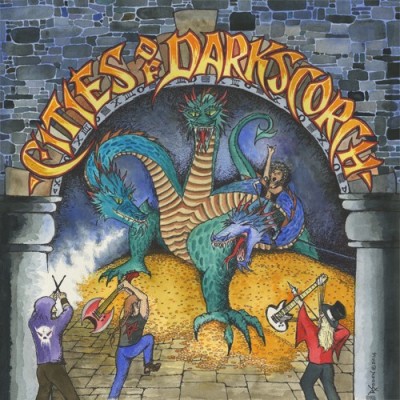
The game is designed to accompany the Numero compilation Warfaring Strangers: Darkscorch Canticles, which collects fantasy-themed underground hard rock. It’s honestly a fantastic compilation. (Have I just mentally budgeted $75 for the game + LP box set? Yes. Yes I have.)
 Katarina von Sporken
 Violent Brain Fever
Leave a comment